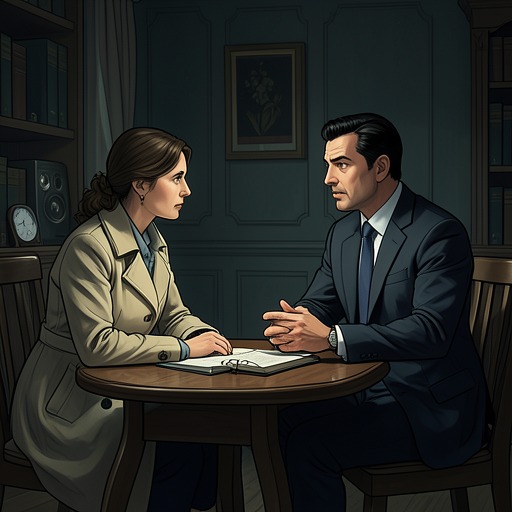
Stogdon House
Night and DayStogdon House is the large country residence of the Otways, situated at Lampsher near Lincoln and reached on foot from Disham. The house gathers several strands of the novel’s action: Ralph Denham travels toward it while imagining Katharine Hilbery there, and Katharine’s stay brings her face to face with the gap between the happiness others expect from her engagement and what she actually feels. Its accumulated architecture and romantic night-time appearance make it more than a backdrop: it is a place where inherited domestic life, social performance, and private uncertainty meet.
Setting and Approach
The address reaches Ralph through a letter signed by Katharine’s father. In a third-class railway carriage, Ralph asks a commercial traveler about a large house in Lampsher inhabited by someone named Otway, then takes the letter from his pocket to check the wording: “Stogdon House, Lampsher, Lincoln.” The traveler knows nothing of the Otways but advises Ralph that someone in Lincoln can direct him. Ralph says he must walk over from Disham, although he knows the letter gives him no invitation and offers no reason to believe Katharine is at the house. It establishes only that the address will be Mr. Hilbery’s for a fortnight.
That gap between what Ralph knows and what he hopes shapes his approach to the place. Looking across the gray fields, he imagines Katharine among trees on a slope, with a yellow light appearing and disappearing below them. His vision settles on the old gray house, and he thinks of Katharine as present there, tender and silent. Yet the imagined scene stops short of fully admitting the actual complication of her engagement to William Rodney. Stogdon House therefore enters the story first as a destination partly made out of Ralph’s longing, before it appears through Katharine’s experience of its rooms and grounds.
Architecture and Domestic World
The house stands about half a mile beyond Disham’s village. Its form records centuries of addition around a great kitchen, with narrow red tiles. The Rector points out the thick walls, old ceiling beams, ladder-steep staircases, changes of level, and deep tent-like attic roofs where swallows have nested and a white owl once appeared. These details give the building a long, layered history, but the successive additions have not produced anything especially interesting or beautiful. Age here is palpable without being idealized: the house has accumulated, rather than resolved, its past.
Its garden is more deliberately ordered. The lawn before the drawing-room windows is uniformly green and without daisies; straight paths run past tall flower beds to a grassy walk. The Rev. Wyndham Datchet paces there at the same hour each morning, using a sundial to measure time and connecting the walk to the Horace odes he recites from memory. He inspects the flowers and removes those that are withered or overblown. On rainy days he transfers the same routine to his study, where he paces and straightens books or adjusts the brass crucifixes on the mantelpiece. The grounds and house thus contain distinct forms of time: the measured repetition of Wyndham’s habits and the much longer, irregular time embodied in the building itself.
Katharine’s Christmas Visit
During Katharine’s stay, the house becomes the setting for a private disquiet she cannot readily explain to her relatives. She has arrived two days earlier and is surrounded by cousins, some her age or younger, whose bright, searching attention seems to look for something amiss between her and Rodney. No one voices a criticism, but the cousins leave the engaged couple alone together; under their scrutiny, Katharine begins to notice that she may want, or at least miss, something she had not consciously felt was absent in London. Her accustomed ability to satisfy other people’s expectations makes this uncertainty especially unsettling.
One night she leaves the family party and walks along a gravel path beneath a pergola, where leafless clematis can obscure parts of the sky. At the stone seat the stars are visible, apart from a line of elms and the low stable building, whose chimney sends up a wavering trace of light. She goes outside not primarily to study the heavens but to escape her terrestrial discontent. At Christmas, the stars briefly seem to join the human celebration; then their scale overwhelms human history, and her imagination moves between cosmic vastness and romantic scenes before the cold brings her back to her body and the house.
Seen from the garden, Stogdon House seems pale, romantic, and nearly twice its actual size. Its curved bow windows glow reddish yellow, giving the front the appearance of a broad ship at sea. A shallow semicircle of steps leads to a large door that Katharine has left ajar. Inside, the square hall is crowded with horned skulls, sallow globes, cracked oil paintings, and stuffed owls. The house’s suggestive, almost theatrical exterior gives way to an interior crowded with inherited objects and signs of age. Katharine pauses at a door where she hears her uncle Sir Francis playing his nightly game of whist, apparently losing, then goes upstairs and along a narrow passage to Henry Otway’s room.
Narrative Significance
Stogdon House links private emotion to the spaces through which people move and observe one another. For Ralph, the address is a promise his evidence cannot support: he is drawn toward it by a letter that confirms the Hilberys’ temporary residence, not Katharine’s presence or an invitation. His journey exposes how readily imaginative desire can occupy a real place before reality catches up. For Katharine, by contrast, the house is not a romantic destination but a lived family environment in which relatives’ expectations make her engagement newly difficult to understand.
The contrast between these experiences is reinforced by the house’s physical character. The aged, irregular residence and its object-filled hall carry the weight of accumulated domestic history, while the garden’s clipped lawn and Wyndham’s daily route impose order and repetition. Yet neither environment settles Katharine’s feelings. The stars offer momentary escape, but cold returns her to the house and the unresolved social life inside it. Stogdon House thus concentrates the novel’s tension between imagined fulfillment and lived reality: it can look like the scene of a romance from afar, while becoming, from within, a place where an expected happiness is questioned.